5 Reasons Why Your Marketing Automation Agency Fails
Learn why your marketing automation agency might be failing and how to fix strategy, data, and support issues to transform your results and maximize ROI today.

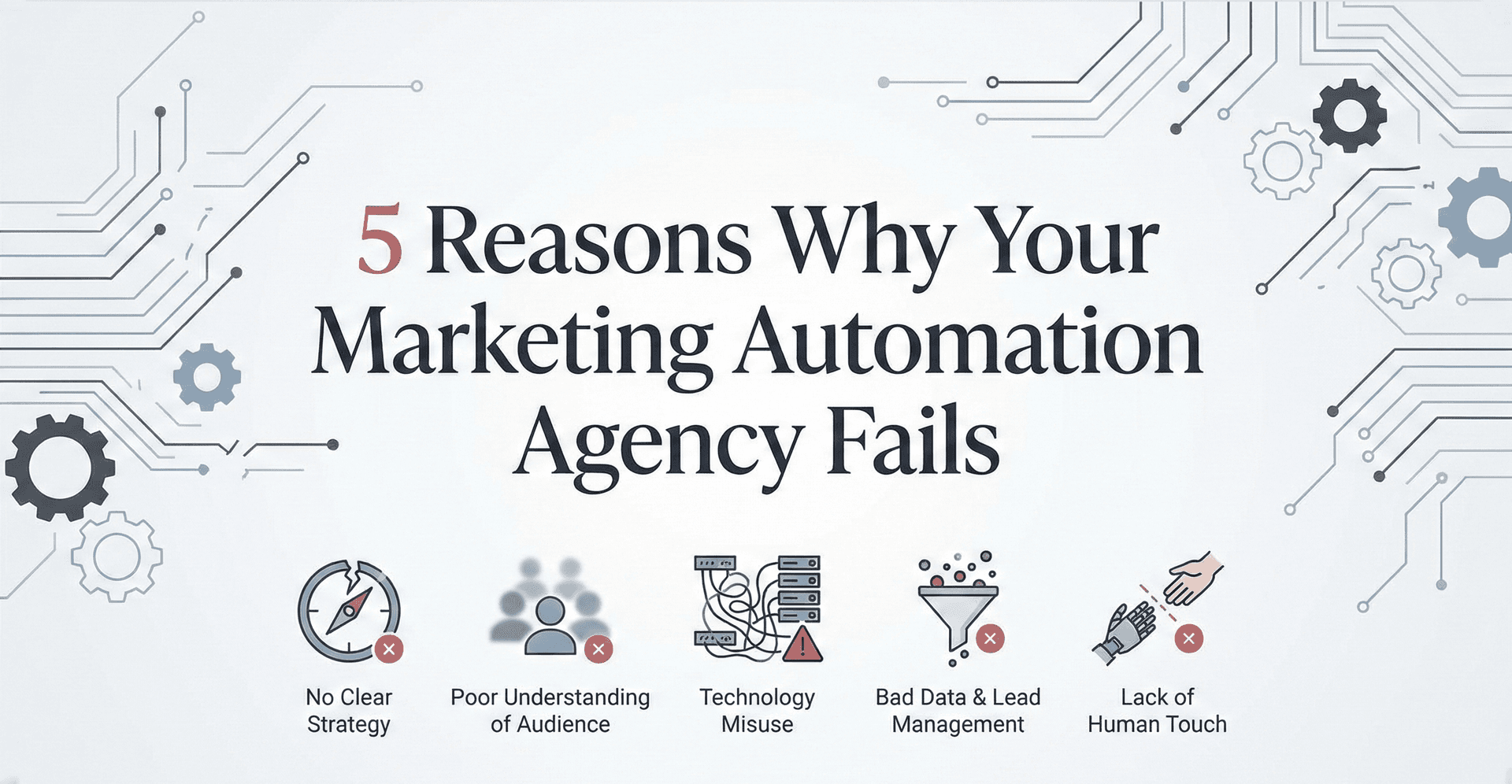
If you've ever invested time, money, and trust into a marketing automation agency and felt like you didn't get the results you expected, you're not alone. I've seen this happen again and again, not because automation doesn't work, but because the agency setup around it is flawed.
In this article, I'm going to share why most marketing automation efforts fail, what the real root causes are, and how you, whether founder, marketer, or operations lead, can fix them for good.
At its core, a marketing automation agency should help businesses automate repetitive marketing tasks, like sending emails, nurturing leads, scoring prospects, and tracking customer journeys, using technology to generate measurable ROI. Done right, automation improves efficiency and engagement; done wrong, it drains budgets and causes frustration.
Despite the promise, many businesses put money into automation and don't see results, often because they skipped fundamental steps. Research shows that many automation projects struggle not because tools fail, but because strategy, data, and human alignment do. (Lean Labs)
I'll walk you through the 5 most common failure reasons, backed by real insights and actionable advice. This strategic mindset is exactly what I've written about in Why I Stopped Building Websites and Started Building Workforces, you need structural thinking before systems execution.
1. No Clear Strategy or Vision
One of the most consistent mistakes I've encountered, both personally and in client work, is jumping into automation without a clear roadmap. This is like trying to build a house without a blueprint: you have tools, materials, and enthusiasm, but no direction.
Misalignment Between Business & Agency Goals
Automation won't help if the goals the agency is pursuing don't match your business objectives. I've seen agencies build complex automation campaigns that looked impressive on dashboards but didn't move the needle on revenue or conversion, because no measurable targets were agreed upon.
Lack of KPIs & Success Metrics
A good strategy starts with measurable outcomes. Are you trying to increase lead-to-customer conversion by 20%? Improve customer retention by 15%? Without KPIs, you have no way of knowing whether your marketing automation agency is delivering value.
Absence of a Phased Roadmap
Many automation projects fail because they try to do everything at once, from social ads to email triggers to CRM integrations. This leads to overwhelm and fragmented execution. The smarter route: implement in phases, validate results, and iterate.
Why Automation Without Strategy Fails
Simply buying tools, setting up workflows, and hoping they magically improve performance doesn't work. Many organizations focus so much on what they can automate that they forget why they're doing it. Even industry experts list undefined goals and lack of planning as a top automation mistake. (Higher Logic)
2. Poor Understanding of Audience & Messaging
One of the biggest reasons automation efforts fail is simple: generic or misaligned messaging.
No Defined Buyer Personas
If your agency hasn't helped you define who you're targeting in detail, including pain points, desired outcomes, and objections, your automation will send the wrong message to the wrong people.
Robotic, One-Size-Fits-All Content
Turning on automated email sequences feels good, until your audience tunes out. Industry articles highlight how irrelevant or incongruent communications damage engagement and perception. (Zapier) When messaging feels generic or automated, customers notice.
No Mapping to Customer Journey
Your audience behaves differently at awareness vs. purchase stages; yet many automation campaigns treat all contacts the same. Effective automation requires understanding where a lead is in the journey and delivering contextually relevant messaging.
If you want to explore more on how AI systems can support deeper personalization and audience understanding, check out posts under the AI Automation category.
3. Technology Misuse & Overwhelm
I always say technology should serve strategy, not replace it. Yet, many teams pick tools before understanding needs, and this leads to the third major failure: technology misuse.
Choosing Tools without Business Fit
There are dozens of automation platforms, from HubSpot to Marketo to ActiveCampaign, but none are perfect out of the box. Choosing tech without evaluating business requirements turns automation into a tangled mess. Industry analyses show that complexity and lack of focus are common culprits in failed automation projects. (Lean Labs)
Too Many Features, Not Enough Focus
Companies often adopt platforms with all the bells and whistles but then try to use every feature at once. This not only overwhelms teams, it slows down execution and dilutes results.
Poor System Integrations
Automation thrives on connected systems. If your CRM, analytics, lead scoring, and email systems aren't synced properly, you'll end up with data fragmentation, and that destroys automation effectiveness.
Lack of Internal Training
Putting automation tools in place is one thing; teaching teams how to use them effectively is another. Without proper training, even the best platforms sit unused or misused.
4. Bad Data & Lead Management
Automation is only as good as the data behind it. Dirty, incomplete, or inconsistent data can cripple segmentation, personalization, and insight, which is why this is a big failure zone.
Poor Data Quality & Segmentation
If your database contains outdated contacts, missing fields, or duplicated records, your campaigns will misfire. According to research, bad data quality is among the top causes of marketing automation breakdowns. (campaigncreators.com)
Leads Lost in the System
Without proper tracking and routing, leads can fall through the cracks. Imagine a hot lead filling out a form but never getting followed up because automation steps weren't properly configured, it happens more often than you think.
Lack of Continuous Data Cleaning
Too often automation teams assume the data stays good forever. Regular cleansing, validation, and updating of lead data is essential for reliable automation.
Vanity Metrics Over Revenue Impact
Tracking opens and clicks feels good, but automation fails when data metrics don't correlate with real business outcomes, like revenue growth, customer loyalty, or lifecycle engagement.
To strengthen data reliability and analyze models critically, you might find value in topics tagged under LLM Reliability.
5. Lack of Human Touch & Continuous Support
Here's the truth: automation doesn't replace humans, it augments them. And when agencies forget this, automation invariably fails.
Automation Without Human Guidance
While tech executes rules, humans interpret context, nuance, and emotion. Removing human oversight completely turns campaigns into cold, robotic broadcasts, damaging trust and engagement in the long run. (Usercentrics)
Poor Ongoing Maintenance
Marketing is dynamic. Audiences change. Competitors evolve. Yet many marketing automation agencies set up workflows, walk away, and never optimize again.
No Follow-Ups with Real People
Automated notifications are terrific for speed, but nothing replaces real follow-up for high-value prospects. Leads that don't get personal attention often disengage.
No Review Cycles
Campaign content, segmentation logic, and performance dashboards require regular audits. Without this, outdated assumptions persist and automation degrades over time.
Ignoring Client Education
If your internal team never learns how automation works, your agency becomes a black box. Collaborative knowledge sharing, not just reporting, is key to lasting results.
Comparison: Agency vs. Freelancer vs. In-House
When deciding how to scale your automation, choosing the right delivery model is as important as the tech iteself. Here is how they compare in the context of marketing automation:
Full-Service Agency: Best for strategic roadmaps and complex cross-platform integrations, but requires higher budget and goal alignment.
Specialized Freelancer: Great for tactical execution of specific tools (e.g., setting up a specific sequence), but often lacks the holistic business strategy.
In-House Team: Ideal for deep domain expertise and daily iterations, but can suffer from 'silo thinking' and lack of exposure to broader industry trends.
Conclusion
Automation can be a powerful engine for growth, but only when implemented with strategy, data discipline, and human-centric thinking.
Here's a quick checklist to get back on track:
✅ Define clear goals and KPIs
✅ Align your business and agency strategy
✅ Clean and integrate your data
✅ Train your internal teams
✅ Review and optimize continuously
Choosing the right marketing automation agency isn't about the flashiest dashboards or the most expensive tools, it's about shared vision, measurement, and adaptive execution.
If you're ready to solve your automation pain points, grow customer engagement, and build reliable revenue systems, I'd love to help.
Key Takeaways
Strategy Must Precede Technology: Automation without a roadmap leads to misaligned goals.
Data Integrity is Critical: Poor data quality sabotages personalization and lead routing.
Human Guidance is Non-Negotiable: Automation should augment, not replace, human nuance.
Focus and Training: Complex tools require proper team training and phased rollout.
Continuous Optimization: Workflows require regular audits and review cycles to stay effective.
FAQs
Frequently Asked Questions
Stay Updated
Get the latest insights on AI automation, voice agents, and production-grade systems delivered to your inbox.
Related Posts
Why I Stopped Building "Websites" and Started Building "Workforces"
For years, I proudly wore the title of Full-Stack Developer. But I realized the code I write shouldn't just display information - it should actually do the work alongside humans.

Beyond the AI Hype: What the Reflection 70B Controversy Teaches Us About Enterprise Automation
Exploring the Reflection 70B controversy and why "Human-in-the-Loop" workflows are essential for reliable enterprise AI automation.
Join the Discussion
Found this article helpful? Share your thoughts, ask questions, or start a conversation with the community on social media.